
AI for Research and Marketing
NVIDIA Released 148,000 Records of Synthetic Salvadoran Personas — Here Is What We Found at Liorant
NVIDIA's Nemotron-Personas-El-Salvador dataset places 148,000 records of synthetic Salvadoran personas directly in the hands of any analyst, marketer, or researcher willing to look. Each record contains seven distinct persona narratives — professional life, sports habits, artistic interests, travel behaviour, culinary preferences, family dynamics, and a general profile — adding up to roughly one million individual persona texts across the full dataset.
The dataset at a glance
Personas by department
San Salvador alone holds 26.8% of the synthetic population; all 14 departments are represented.
25 fields, three tiers
Source: Created by Liorant based on the NVIDIA Nemotron-Personas-El-Salvador dataset.
NVIDIA, in collaboration with Widelabs, designed the dataset for Sovereign AI research — to support LLM training, improve synthetic data diversity, and reduce model collapse. This article explores how research teams can use it as an audience hypothesis-generation layer; that is Liorant's own applied interpretation, not NVIDIA's stated intent.
Liorant ran this dataset through a full analysis pipeline: exploratory statistics across all 148,000 rows, AI-generated embeddings of the narrative fields, an unsupervised segmentation of a 20,000-persona working sample, and a conversational marketing-research demo powered by a small language model. This article presents what the analysis surfaced — findings, patterns, and possible audience hypotheses — and explains what marketing teams and executives can do with a workflow like this.
One framing note before we begin: everything produced from this dataset is exploratory by nature. Synthetic personas represent plausible demographic and narrative diversity, not real consumer behaviour.
Patterns emerging from a 20,000-row sample point toward hypotheses worth testing, not conclusions to act on — which is why Liorant believes this kind of analysis is most valuable at the beginning of an audience-research process, not the end.
What the Nemotron-Personas-El-Salvador dataset contains
The dataset is available at nvidia/Nemotron-Personas-El-Salvador on Hugging Face, distributed in Parquet format as a single training split. It contains 148,000 rows and 25 columns.
Structured demographic fields provide the factual scaffolding for each persona: sex, age, languages spoken, marital status, household type, education level, occupation, urban or rural classification, municipality, department, and country. The occupation field covers 119 CIIU Rev.4 economic-activity classes across eight census employment categories.
Text fields give each persona its depth. NVIDIA's documentation identifies seven core persona narrative fields per record, which together produce approximately one million individual persona texts across the full dataset. The schema also includes six additional contextual text fields. Based on Liorant's analysis, all 13 text columns are unique across all 148,000 rows, with an average combined narrative length of approximately 6,817 characters and 1,165 words per record.
Every field across all 25 columns shows zero missing values. The dataset is structurally complete — every persona can be used without imputation, filtering, or data cleaning.
Diagram
Dataset architecture: 25 fields in three tiers
- personaGeneral profile
- professional_personaCareer & work
- sports_personaPhysical activity
- arts_personaCultural interests
- travel_personaTravel behaviour
- culinary_personaFood & eating
- family_personaHousehold & family
- cultural_background
- skills_and_expertise
- skills_and_expertise_list
- hobbies_and_interests
- hobbies_and_interests_list
- career_goals_and_ambitions
- uuid · sex · age
- languages_spoken
- marital_status · household_type
- education_level · occupation
- area (urban / rural)
- municipality · department · country
Source: Created by Liorant based on the NVIDIA Nemotron-Personas-El-Salvador dataset.
Exploring 148,000 personas without overloading your systems
Loading the full dataset directly into a standard analytics environment would require several gigabytes of memory — beyond what most shared or cloud notebook environments handle comfortably. Liorant's approach in the first phase was to query the dataset's files remotely using an in-memory SQL engine, without ever loading the complete dataset into a local environment.
This produced all descriptive statistics — row counts, schema inspection, missing-value counts, unique-value counts, and top categorical frequencies — through direct queries against the files as they exist on Hugging Face. The only data pulled into memory locally was a 20,000-row random sample, extracted for the downstream segmentation and AI-demo work.
The result: a complete demographic and structural overview of all 148,000 personas, produced without the infrastructure costs or memory requirements that normally accompany a dataset of this size.
Key structural finding (Liorant analysis). Every one of the 25 columns registers 0% missing values. All 13 text columns each contain 148,000 unique entries — every persona holds a fully distinct text in every field. From a data-quality standpoint, the dataset is unusually clean.
Workflow
The three-notebook analysis pipeline
Source: Created by Liorant based on the NVIDIA Nemotron-Personas-El-Salvador dataset.
What the data shows: key demographic and occupational patterns
The exploratory analysis of all 148,000 personas reveals several structural patterns. These are descriptive findings from the synthetic dataset — direct counts and distributions — not inferences about real Salvadoran consumers.
Age
The synthetic population spans ages 18 to 100. The mean age sits at 42.8 years (standard deviation 17.6); the median is 40. The interquartile range runs from 28 to 55 — half the population falls between those ages. The distribution is broader than a typical young-adult marketing sample and more representative of the full working-age-to-elderly spectrum.
Visual 1
Age distribution — Nemotron Personas El Salvador (n = 20,000 sample)
Source: Created by Liorant based on the NVIDIA Nemotron-Personas-El-Salvador dataset.
Sex
A slight female majority — 79,632 female personas (53.81%) to 68,368 male (46.19%). This reflects design decisions in the dataset rather than census proportions, though it is broadly consistent with El Salvador's demographic structure.
Visual 1b
Sex distribution — full dataset
Slight female majority reflects dataset design choices, not census data.
Source: Created by Liorant based on the NVIDIA Nemotron-Personas-El-Salvador dataset.
Languages spoken
| Language | Count | % |
|---|---|---|
| Spanish only | 134,650 | 90.98% |
| Spanish and English | 12,770 | 8.63% |
| Spanish and another language | 453 | 0.31% |
| Salvadoran Sign Language (LESSA) | 89 | 0.06% |
| Spanish and indigenous language | 37 | 0.03% |
| Indigenous language only | 1 | 0.00% |
Source: Created by Liorant based on the NVIDIA Nemotron-Personas-El-Salvador dataset.
For any team targeting El Salvador, this confirms that Spanish-only creative reaches the overwhelming majority of any realistic audience. Bilingual Spanish-English content is relevant for under 9% of the synthetic population, concentrated in groups with likely higher formal education and urban residence.
Visual 1c
Languages spoken — synthetic population
Bilingual Spanish-English personas cluster in urban, higher-education profiles.
Source: Created by Liorant based on the NVIDIA Nemotron-Personas-El-Salvador dataset.
Education level
| Level | Count | % |
|---|---|---|
| Bachillerato (high school) | 45,436 | 30.70% |
| Primaria (primary) | 36,437 | 24.62% |
| Secundaria (middle school) | 26,057 | 17.61% |
| Universitario (university) | 17,766 | 12.00% |
| Ninguno (no formal education) | 17,363 | 11.73% |
| Técnico (technical) | 3,864 | 2.61% |
| Posgrado (postgraduate) | 1,077 | 0.73% |
Source: Created by Liorant based on the NVIDIA Nemotron-Personas-El-Salvador dataset.
More than half the synthetic population holds at most a primary or middle-school education. University-level education appears in just 12% of personas. This has direct implications for how brands calibrate message complexity, financial-product design, digital onboarding, and trust-building across different audience groups.
Visual 2
Education level distribution — 148,000 synthetic personas
Source: Created by Liorant based on the NVIDIA Nemotron-Personas-El-Salvador dataset.
Department — geographic distribution
San Salvador concentrates 26.76% of the synthetic population. La Libertad, Santa Ana, and Sonsonate add another 30.8%. All 14 departments appear, with the remaining ten collectively accounting for roughly 42% of personas. Any brand treating El Salvador as a single market centred on the capital is, by the dataset's own distribution, leaving the majority of the audience unaddressed.
Visual 3
Synthetic personas by department
San Salvador concentrates the population; the remaining 13 departments fragment the rest.
Source: Created by Liorant based on the NVIDIA Nemotron-Personas-El-Salvador dataset.
Top occupations
The dataset covers 119 CIIU Rev.4 economic-activity classes. The seven most frequent occupations in the full dataset, based on Liorant's analysis:
| Occupation | Count | % |
|---|---|---|
| Food services and street food | 12,359 | 8.35% |
| Grain and legume cultivation | 9,324 | 6.30% |
| Non-specialised retail (food-led) | 9,163 | 6.19% |
| Domestic household employment | 8,996 | 6.08% |
| Building construction | 6,862 | 4.64% |
| Bakery product manufacturing | 6,137 | 4.15% |
| Garment manufacturing | 5,068 | 3.42% |
Source: Created by Liorant based on the NVIDIA Nemotron-Personas-El-Salvador dataset.
The economy represented skews toward informal commerce, agriculture, domestic work, and food production — consistent with the structure of El Salvador's real labour market, where the informal sector accounts for a substantial share of employment. Brands designing campaigns around formal, salaried workers will, by these distributions, be optimising for a minority profile.
We analyzed four audience patterns emerging from the segmentation analysis
The second phase moved from full-dataset descriptive statistics to a working sample of 20,000 randomly selected personas. The goal: test whether AI-driven segmentation of the narrative text fields produces coherent audience groupings that go beyond what structured demographic columns alone reveal.
The approach combined the seven official persona fields and the available contextual text fields into a single text representation, then used a multilingual AI model to convert each persona's combined narrative into a numerical vector — a mathematical representation of its meaning. Those vectors were grouped using an unsupervised algorithm, tested at multiple group sizes to identify the most internally coherent solution.
Workflow
How the audience segments were built
Source: Created by Liorant based on the NVIDIA Nemotron-Personas-El-Salvador dataset.
A statistical measure of segment cohesion — how clearly separated and internally consistent each grouping is — peaked at four segments, scoring 0.1185 on a scale where higher is better. That score is modest in absolute terms, as expected for rich narrative text rather than purely numerical data, but it meaningfully outperforms every other group count tested (three through ten).
Visual 4
Segment cohesion score by number of audience groups
Higher scores indicate more internally consistent groupings.
Source: Created by Liorant based on the NVIDIA Nemotron-Personas-El-Salvador dataset.
The four segments below represent patterns that surfaced from the narrative analysis of the working sample. They are audience hypotheses grounded in the data, not verified customer profiles. Their value is in structuring the questions a team should take into real research — not in replacing that research.
Segment A — Informal service workers (28.8% · 5,757 personas)
The largest segment by volume and the most gender-specific in the dataset. 97.99% of personas in this segment are female. Occupations cluster around domestic household employment (831), street food and restaurant work (509), non-specialised retail (485), and garment manufacturing (328). Education centres on primary school (28.2%) and bachillerato (27.5%), with 14.3% holding no formal education. The segment skews toward cities and mid-sized towns outside the capital — La Libertad (18.7%), Santa Ana (12.1%), Sonsonate (10.9%); 71% urban.
What this suggests for marketing teams. The narratives describe women managing informal cash economies, running household purchasing, and making daily decisions with constrained but consistent budgets. Hypotheses worth testing: financial-access products and mobile money, family-security messaging, practical consumer goods, small-business tools framed around daily operational needs. The right message here almost certainly differs from what performs in formally employed urban audiences — and the right channel is unlikely to be digital-first.
Segment B — Physical labour and rural economy (30.0% · 6,004 personas)
The largest segment by persona count is almost exclusively male — 94.85% male — and concentrated in young ages, with the modal range 20–29. Occupations are dominated by grain and legume cultivation (1,058), building construction (636), vehicle maintenance and repair (207), land transport (185), and public security (164). Bachillerato is the modal education level (30.2%), followed by primary school (26.0%). This is the only segment with meaningful rural representation: 34.9% rural, against a sample average near 23%.
What this suggests for research and marketing teams. The narratives depict young men in physical, often outdoor work with limited formal infrastructure. Digital reach is likely lower than in the urban-services segment; connectivity gaps and distance from formal financial services recur as context. Hypotheses worth testing: offline and radio channels, messaging around practical tools and income stability, agricultural inputs, insurance framed around work-related risk, and community-oriented creative over individualistic aspiration.
Segment C — Urban services professionals (26.8% · 5,365 personas)
The most geographically concentrated and most gender-balanced segment. 71.3% come from San Salvador department — 32.3% from San Salvador Centro alone. It is the only segment with roughly equal male and female personas (50.2% male, 49.8% female). University education reaches 17.2% — five points above the dataset average — and 89.2% are urban. Top occupations reflect a more diverse services economy: food services (360), retail (309), domestic employment (293), construction (250), other services (250).
What this suggests for research and marketing teams. This is the profile most brands picture when they imagine an El Salvador consumer. It is real — but it represents roughly one in four personas and concentrates almost entirely in the capital. Hypotheses worth testing: digital channels, financial services, professional-development products, lifestyle messaging. The higher education presence and urban concentration make this the segment most likely to respond to digital-first creative and platform-mediated commerce.
Segment D — Food economy entrepreneurs (14.4% · 2,874 personas)
The smallest and most occupationally distinct segment. Bakery product manufacturing accounts for 847 personas; food services and street food for 753. Non-specialised food retail (349), market food stalls (249), and specialised food retail (229) follow. 76.4% are female. Education concentrates at bachillerato (30.2%) and primary school (25.5%). Unlike Segment C, this group is geographically spread — San Salvador (15.9%), Santa Ana (11.8%), La Libertad (10.6%), Sonsonate (9.5%) each contribute meaningfully.
What this suggests for research marketing teams. The narratives depict women running their own food businesses — managing suppliers, pricing products, serving regular customers, navigating informal supply chains. What they lack, in narrative context, is access to formal credit, business-management infrastructure, and supply-chain stability. Hypotheses worth testing: microfinance and working capital, ingredient and packaging supply, point-of-sale tools, and business-management messaging framed around operational efficiency.
Visual 5
Segment size and gender composition across the working sample
Source: Created by Liorant based on the NVIDIA Nemotron-Personas-El-Salvador dataset.
Visual
Four segment profile cards
Segment A — Informal service workers
Segment B — Physical labour economy
Segment C — Urban services
Segment D — Food & bakery economy
Visual
Audience segment profiles across five dimensions
| Dimension (% of segment) | Segment A Informal service | Segment B Physical labour | Segment C Urban services | Segment D Food economy |
|---|---|---|---|---|
| Female | 98% | 5% | 50% | 76% |
| Urban | 71% | 65% | 89% | 70% |
| University-educated | 9% | 7% | 17% | 11% |
| From San Salvador dept. | 13% | 12% | 71% | 16% |
| Rural | 29% | 35% | 11% | 30% |
Each cell is shaded within its own row — the darkest cell marks the segment that scores highest on that dimension. Approximate values from the 20,000-persona working sample.
Source: Created by Liorant based on the NVIDIA Nemotron-Personas-El-Salvador dataset.
Research methods: before synthetic personas and after
Most teams working on El Salvador — or any Central American market — begin with one of three starting points: senior stakeholder intuition, recycled global persona templates ("María, 35, middle-income mother"), or a formal research cycle that takes six to ten weeks and costs more than $10,000 before the first structured hypothesis appears. Here is what changes when a synthetic persona dataset enters the workflow.
Visual
Research timeline: traditional vs. AI-assisted
Source: Created by Liorant. Cost and timeline ranges are Liorant estimates for the Central American market.
| Dimension | Traditional approach | With synthetic personas |
|---|---|---|
| Time to first hypothesis | 4–10 weeks | Hours |
| Cost to produce segments | $10,000+ | Open-source tooling + compute only |
| Geographic resolution | City-level or broad region | Municipality-level, all 14 departments |
| Occupational granularity | Broad categories | 119 CIIU Rev.4 classes |
| Narrative depth | Closed survey responses | Long-form narratives, 11 life dimensions |
| Iteration speed | New fieldwork per hypothesis | Re-run in hours |
| AI workflow readiness | Limited — structured data only | Direct: embeddings, semantic search, LLM-ready |
| Validation requirement | Self-validating (real respondents) | Requires real-data validation before any decision |
Source: Created by Liorant. Comparison reflects Liorant's applied use of the NVIDIA Nemotron-Personas-El-Salvador dataset.
The final row is the most important. Synthetic personas accelerate the hypothesis-formation phase of research, not the conclusion phase. Every segment, pattern, and campaign idea produced from this dataset requires validation against real customer data, CRM records, field interviews, or campaign results before any strategic decision rests on it. The competitive advantage is not in replacing fieldwork — it is in arriving at fieldwork with better-formed questions.
An AI research assistant built on the same dataset
The third phase built an interactive layer on top of the segmentation work. The precomputed narrative vectors and the clustered sample were loaded into a lightweight pipeline connecting a semantic-search layer to a small instruction-following language model — running entirely on a standard cloud GPU at no incremental cost.
A user types a marketing question in natural language. The system identifies the five persona narratives most semantically similar to the question, then passes them to the language model, which generates a structured response — audience hypothesis, campaign brief, segment summary, or message framework — grounded in the retrieved personas rather than the model's general training.
Workflow
How the AI marketing-research assistant works
Question: "Which personas might respond to a digital financial-education campaign?"
income stability, family financial security
trust in informal providers, limited digital experience
WhatsApp groups, community radio, in-person referrals
customer interviews, CRM data, pilot campaign results
Source: Created by Liorant. Pipeline built on the NVIDIA Nemotron-Personas-El-Salvador dataset.
Live interface
Creating a research query and consulting in natural language
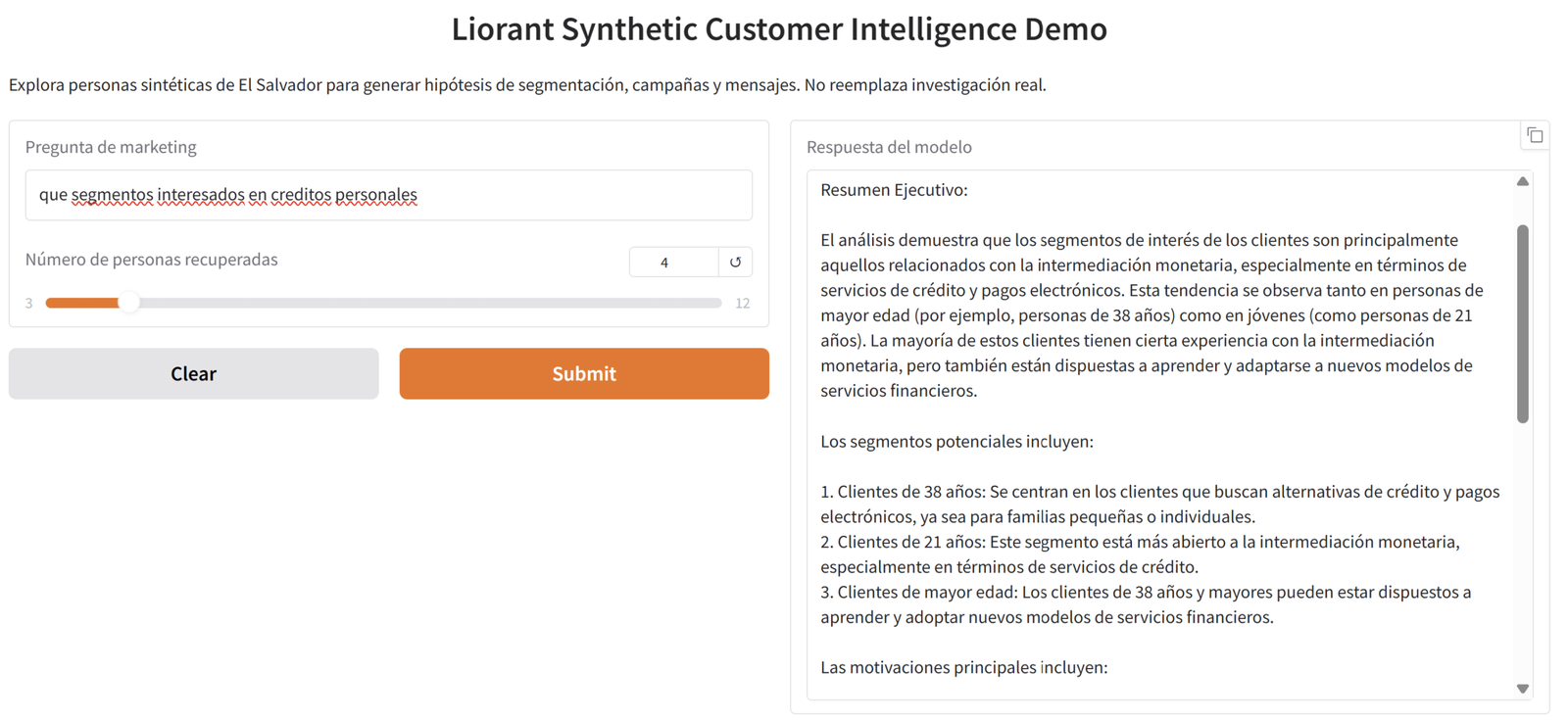
The assistant in use. A team member loads the source material and types a question in plain language — here in Spanish — and the system returns a structured, source-grounded answer in the same language. No query syntax, no data export, no technical step in between: the research question and the consultation happen in one conversation.
Source: Liorant working interface, built on the NVIDIA Nemotron-Personas-El-Salvador workflow.
This is not market research. It is a hypothesis accelerator — a tool that helps a marketing team enter a brief with structured, testable assumptions rather than unvalidated intuitions. A browser-accessible interface built at the end of the pipeline makes it usable by non-technical teams, requiring no data literacy to operate.
How to reproduce this workflow
The full pipeline runs in Google Colab's free tier with no local installation. The technical complexity sits in the notebooks; the business team's input is the question, the product, and the audience context.
- Run the exploratory analysis. The first notebook connects to the dataset files remotely, runs all descriptive statistics as database queries, and exports a 20,000-row working sample.
- Save the working sample. Download the sample file (~60–80 MB) before moving on.
- Run the segmentation analysis. The second notebook generates narrative embeddings, evaluates multiple segment counts, applies the four-segment solution, profiles all segments, and exports the segmented sample + embedding file.
- Save two output files. The embedding file and the segmented sample are both needed for the demo.
- Run the marketing-research demo. The third notebook loads the two files, builds the semantic-search layer, connects a small language model, and launches a browser interface.
Workflow
Five steps from dataset to working marketing interface
Source: Created by Liorant. Workflow built on the NVIDIA Nemotron-Personas-El-Salvador dataset.
What this workflow cannot replace
Synthetic personas accelerate hypothesis formation; they do not substitute for real-world validation. The Nemotron dataset is a starting point for structured hypothesis generation — one of the most valuable phases in a research process, and one that marketing teams in Latin America consistently underfund. It is not a shortcut past the research that follows.
Visual
What synthetic personas do not cover
Real customer interviews
Only real people can confirm whether a motivation or barrier actually applies to them.
CRM & behavioural data
Purchase frequency, churn signals, and lifetime value require transaction records.
Campaign performance
Only live A/B tests reveal whether a message actually performs.
Cultural & local expertise
No dataset replaces the knowledge of someone who lives within the culture being studied.
Ethical oversight
AI-assisted research affecting real communities requires human review and documented validation.
NVIDIA-documented dataset limits
Under-represents Indigenous and Afrodescendant communities · may carry inherited gender-role assumptions · Salvadoran Spanish approximated by generative AI · religion not modelled.
Source: Created by Liorant. Dataset limits per the official NVIDIA dataset card.
How Liorant helps research and marketing teams build this
Liorant builds and runs AI systems for marketing, operations, and legal teams across Spain, Colombia, and El Salvador. The workflow in this article represents a category of capability we call AI Customer Intelligence — combining structured data, narrative embeddings, segmentation, semantic search, and lightweight language models into repeatable research tools that marketing teams can operate themselves.
A typical engagement starts with a product launch, a regional expansion, or an audience question existing research has not answered. Liorant designs and deploys an AI-assisted audience-research workflow calibrated to the client's data environment — CRM records, campaign data, product usage, or a synthetic dataset as a starting scaffold — and delivers a working system in four to six weeks.
The deliverable is not a report. It is a running tool the marketing team operates themselves, backed by Liorant's AI engineering team for ongoing maintenance, iteration, and expansion. We report results in business terms: hypotheses generated, research cycles compressed, campaign-brief quality improved.
See how Liorant delivers working AI systems in four to six weeks →
Frequently asked questions
Is the Nemotron-Personas-El-Salvador dataset free to use?
Yes. NVIDIA published it on Hugging Face under a Creative Commons Attribution 4.0 International (CC-BY 4.0) licence, which permits use for any purpose — including commercial — provided appropriate credit is given to NVIDIA. Always verify the current terms on the dataset card before use.
Do the four segments represent real Salvadoran consumers?
No. The segments are patterns that emerged from an AI-driven analysis of a 20,000-persona sample drawn from a synthetic dataset. They represent plausible groupings worth investigating, not verified customer profiles. Every hypothesis they generate requires validation with real people before informing a decision.
Do we need a technical team to work with this data?
Not if you work with Liorant. All technical design, implementation, model selection, and operations sit with Liorant's engineering team. A marketing executive contributes the business question, the strategic context, and the validation priorities.
What is the difference between a synthetic persona and a buyer persona?
A buyer persona is a composite built from real customer research. A synthetic persona is a computationally generated profile representing plausible demographic and narrative diversity, not a specific real individual. Buyer personas summarise validated knowledge; synthetic personas explore the hypothesis space before that validation begins. The two are complementary, not interchangeable.
What is the first step for a company interested in this capability?
A 30-minute discovery session with Liorant. We review your existing data assets, identify the audience question most worth answering, and outline how an AI-assisted research workflow would be calibrated to your market, product, and team — without any upfront commitment.
Start building AI-assisted audience research
Teams that wait two to three months for fieldwork before forming a single testable hypothesis will fall behind teams that enter the field with sharper questions. Synthetic persona analysis does not shorten fieldwork — it improves what teams bring to it.
The Nemotron dataset, freely available, analysed in hours, and surfacing four distinct audience patterns in El Salvador's synthetic population, is an early demonstration of how that shift works in practice. The teams that act on it first — validating the most promising hypotheses with real customers — will build a structural advantage in market understanding.
Start with a free 30-minute AI discovery session.
We identify your highest-value audience-research opportunity and explain exactly how Liorant can help — no slides, no pitch.
Book your session →